
Key Takeaways:
- If you’re unsure of a guest's marital status, Ms. is always a safe choice to use.
- Mrs. should be used to address women who are, or have been, married.
- Miss should only be used to address young, unmarried women.
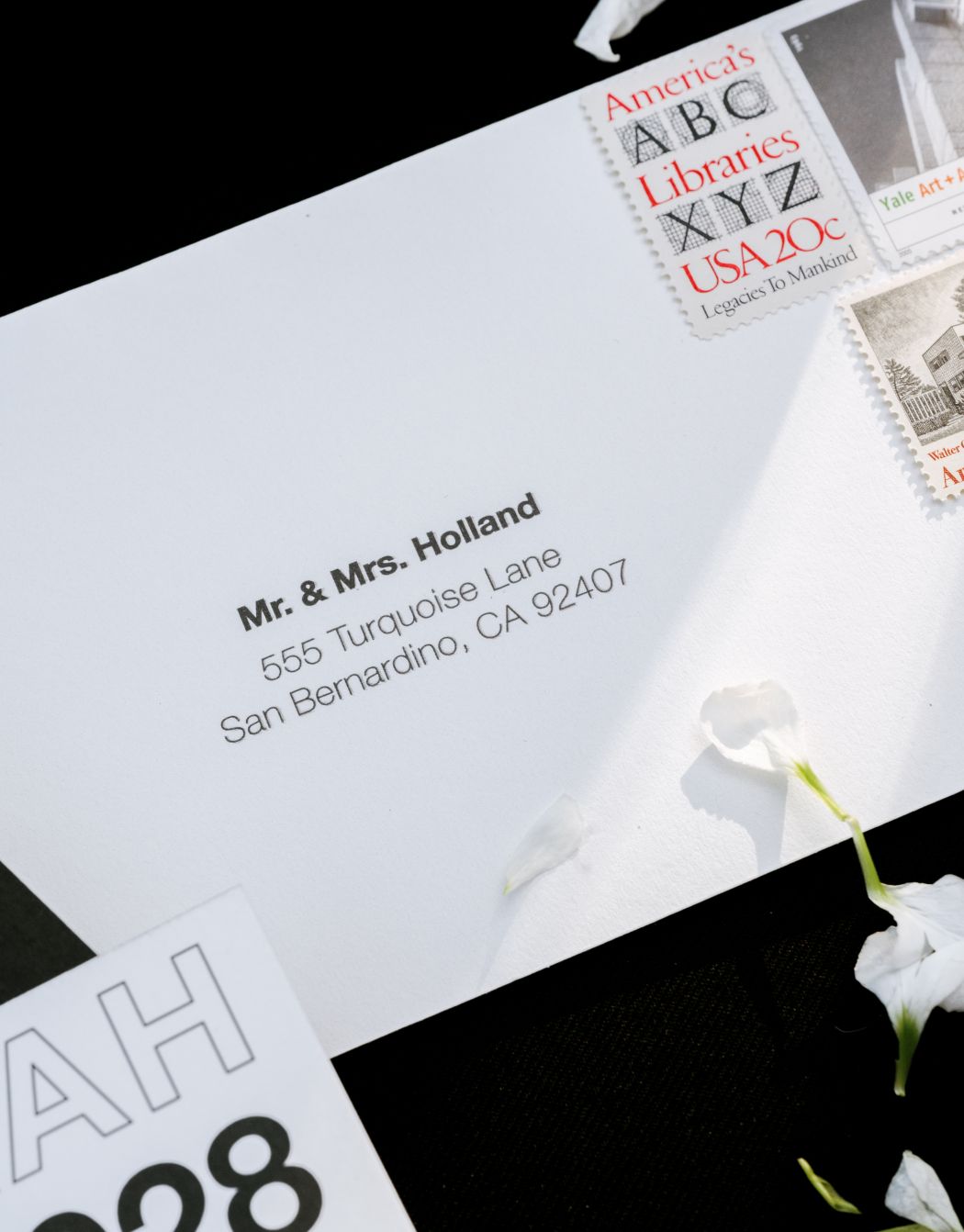
When it comes to adding titles to your save the date envelopes, wedding invitation envelopes, place cards, and more, men are easy: It’s always Mr., regardless of age or marital status. For women, on the other hand, titles are dependent on age, marital status, and more.
To clear up any confusion, we’ll explain everything below so you can address your wedding invitations perfectly.
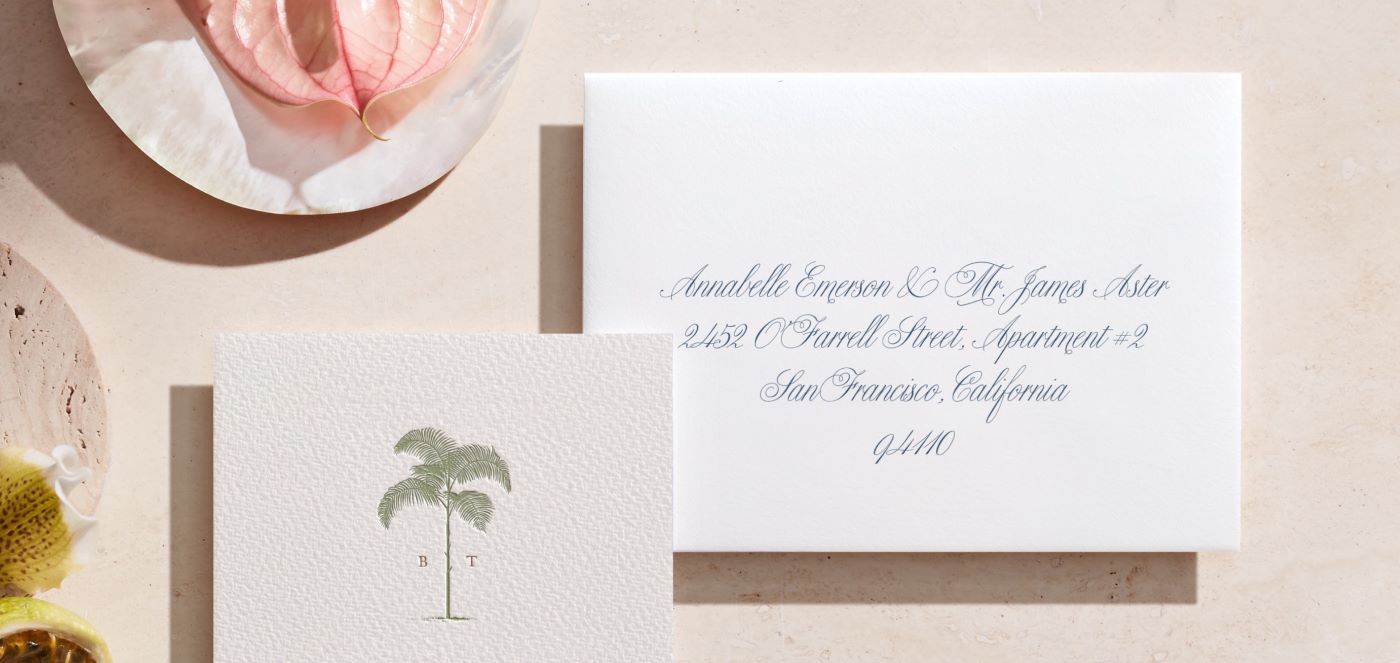
Palm Invitation by Melinda Denison
MISS VS. MS. VS. MRS. CHEAT SHEET
We’re going to explain the ins and outs of how and when to use each of these titles, but here’s an at-a-glance cheat sheet you can reference as you address your save the dates and wedding invitations.
| WHEN TO USE | MISS | MS. | MRS. | MX. |
|---|---|---|---|---|
| Married | ✓ | ✓ | ||
| Unmarried | ✓ | ✓ | ✓ | |
| Separated, not divorced* | ✓ | ✓ | ✓ | |
| Divorced* | ✓ | ✓ | ✓ | |
| Widow* | ✓ | ✓ | ||
| Marital status unknown | ✓ | ✓ | ||
| Under 18 | ✓ | ✓ | ✓ |
*While Mrs. can technically be used for women who have been married, but are now widowed, separated, or divorced, it may not be their preferred title. If you’re unsure which title to use, Ms. is always a safe choice.
WHAT’S THE DIFFERENCE BETWEEN MRS., MISS, MS., AND MX.?
MRS.
Mrs. is the title given to women who are married or were married at one time. Pronounced missus, this title is typically used to show respect to married women or when addressing a woman of authority.
MISS
Miss is the title given to young women, and is typically used for women and girls who are under 18. It can also be used to reference any unmarried woman, although more mature unmarried women may prefer Ms.
MS.
Think of Ms. as the closest equivalent to Mr. It is a catch-all title, and is most commonly used when you’re unsure of a woman’s marital status. It can also be used for a single woman when “Miss” feels too juvenile, or a woman who was married but is now divorced or separated. Finally, it is also commonly used to refer to married and unmarried women in professional contexts, or in contexts in which their marital status is unimportant.
It is pronounced mizz (like quiz).
MX.
Mx. is a gender-neutral title that can be used for nonbinary guests of all ages, as well as those who use they/them pronouns. Pronounced mix, it can apply to people who are single, married, separated, divorced, or widowed.
MISS VS. MS. VS. MRS. VS. MX.: HOW TO ADDRESS YOUR WEDDING INVITATIONS & SAVE THE DATES
MRS.
Mrs. is the proper title for a woman who is or was married, whether she has taken her spouse’s last name or not. If you know that the woman you’re addressing is married, Mrs. is the way to go.
- Married, same last name: Mr. and Mrs. Maleki
- Married, different last names: Mr. Alex Scott and Mrs. Katie Jacobs
- Widow: Mrs. Martha White
MISS
You can comfortably use Miss when addressing girls and young unmarried women. At a certain age, Miss can start to feel too young—if you’re addressing an unmarried woman over the age of 25, Ms. is the way to go.
- Miss Gonzalez
- Miss Rebecca Goldstein
MS.
Because Ms. doesn’t necessarily indicate marital status, it is a great neutral title for addressing the women on your guest list. Ms.should be used if you’re unsure whether a guest is married or if she’s unmarried and over the age of 25.
It is also a safe bet to use Ms. when addressing women who are separated from their husbands or are divorced, even if they have not changed their last name.
- Unmarried couple: Mr. Matthew Bennett and Ms. Brittney Souza
- Divorced woman: Ms. Jessica Neely
- Unmarried woman: Ms. Wetherell
MX.
When addressing someone who is nonbinary or uses they-them pronouns, use the title Mx. Even if someone identifies with a specific gender, you may still use Mx., especially if you’re unaware of the recipient's preferred title.
Like Ms., Mx. can be used regardless of marital status.
- Married couple with the same last name: Mrs. and Mx. Callahan
- Couple with different last names: Mr. Jeorge Rodriguez and Mx. Olivia Smith
- Unmarried person: Mx. Taylor Johnson
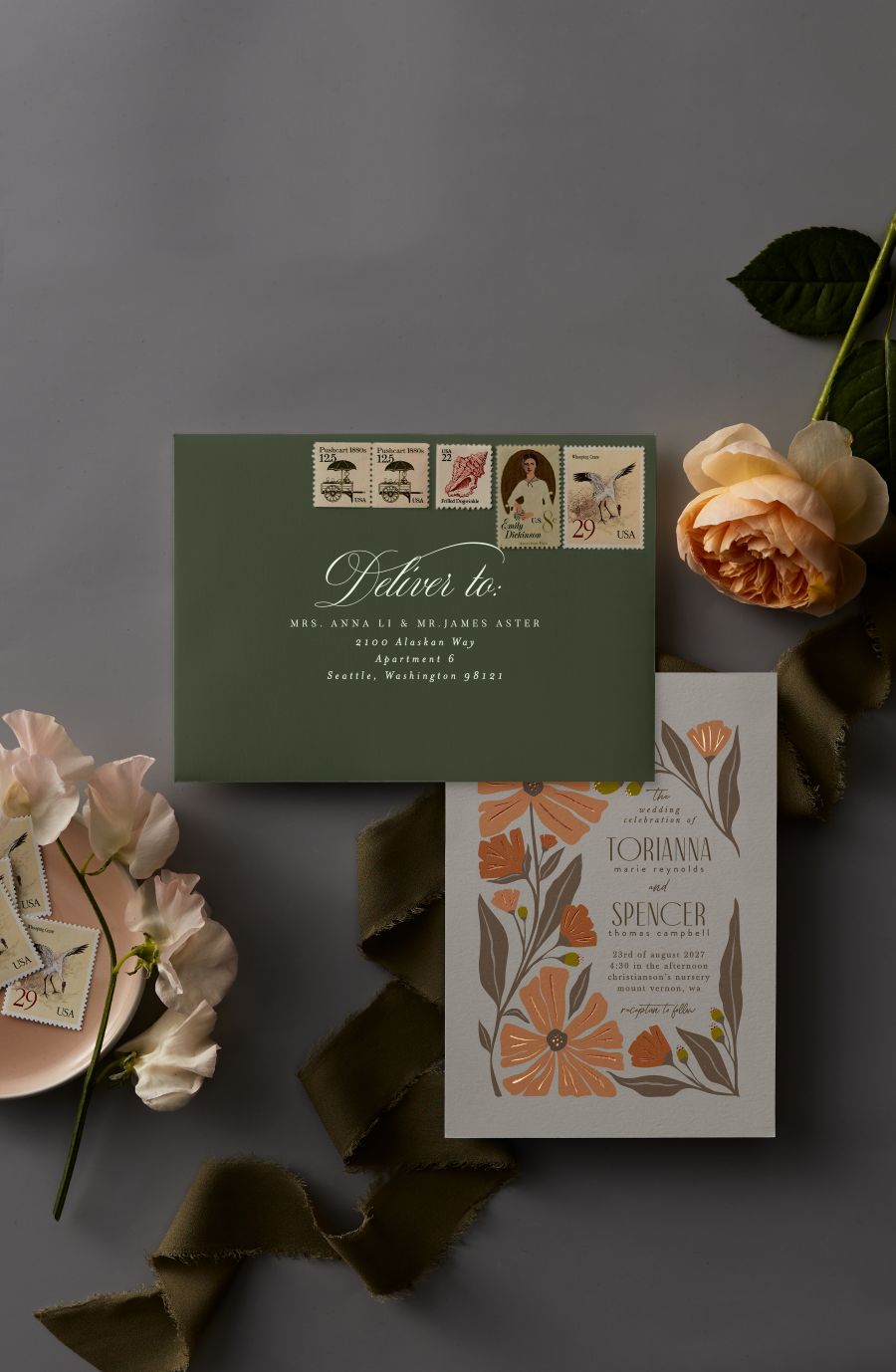
ADDITIONAL TITLES TO KNOW WHEN ADDRESSING WEDDING INVITATIONS
Besides Mr. and Miss vs. Ms. vs. Mrs. vs. Mx., there are some additional titles you may need to use when addressing your wedding invites.
JUDGES
If you’re mailing a wedding invitation to a guest who is a judge, use the title “The Honorable” and list him or her first, followed by the name of their partner if they have one.
- Wife is a judge, husband is not: The Honorable Sonya Patel and Mr. Niven Patel
DOCTORS
If a guest is a medical doctor or has a Ph.D., it’s appropriate to address the envelope using the title "Doctor.”
- Husband is a doctor, wife is not: Doctor Michael and Mrs. Sabrina Lee
- Wife is a doctor, husband is not: Doctor Sharon and Mr. Erik Sheffield
- Both partners are doctors: The Doctors Alfonso or Drs. Sonia and Carlos Alfonso
MILITARY PERSONNEL
For guests with military titles, spell out the titles in full. If both guests have military titles, then list the guest with the higher rank first. When addressing the wedding invitation envelope, indent the second line if both titles don't fit on one line.
- Wife has a military title, husband does not: Captain Sarah Chao and Mr. Jason Chao
- Husband has a higher military title than wife: Lieutenant General White and Captain Ojeda
- Both partners have the same title: Colonels Joanna and Marcus Gallary
LAWYERS
If you are inviting a guest who is an attorney, you do not need to use "Esquire" or "Esq." when addressing their wedding invitation. Although you can if you know that the title is important to them.
MISS VS. MS. VS. MRS. FREQUENTLY ASKED QUESTIONS
Will I be "Ms." or "Mrs." after I get married?
It depends. Typically, brides who change their last name after the wedding go by Mrs. since it indicates they share the same last name as their husband (e.g., "Mr. and Mrs. Wong"). You can also go by Ms. if you'd prefer your title not to be associated with your marital status. If you're keeping your maiden name, you have options: You can go by Ms. or Mrs.
How do I address the envelope to two women who are married to each other?
When each member of the couple uses a different last name, use Ms. as their titles and list each name in alphabetical order by last name, as in "Ms. Kristin Hampton and Ms. Sarah Lee." However, if you know the couple prefers Mrs., use that title instead.
If both partners use the same last name, use Ms. as their titles and list each name in alphabetical order by first name, as in "Ms. Christine Azoveda and Ms. Stacey Azoveda." Again, if you know the couple prefers Mrs., then use that title instead.
When addressing envelopes, whose name should go first?
Traditionally, a woman’s name preceded a man’s on an envelope address when spelling out both first names, as his first and surname were not separated (for example, Mrs. Jane and Mr. John Kelly). If only the last name was being used, typically you’d list Mr. and then Mrs. (for example, Mr. and Mrs. Kelly).
Nowadays, either order is acceptable.
Do you use Mrs., Ms., or Miss if a guest is divorced?
After a divorce, if a woman keeps her married name, you can either use Mrs. or Ms. to address the guest, followed by her first name and married name. If she is using her maiden name, then use Ms. along with her first name and maiden name. It’s always best to find out what she prefers to go by.
Because Miss refers to young unmarried women, it is never appropriate to use it to address a woman who is divorced.
What if she's separated but not divorced?
If a guest is separated but not divorced, she is likely still using her married last name. If this is the case, then you can either use Mrs. or Ms. to address the guest. As always, though, it is best to find out what she prefers.
What if she's widowed?
Traditionally, a widow retains her husband's name until she remarries. Regardless, when addressing an invitation to her, you can use Mrs.
Address Your Wedding Stationery with Confidence
For more examples and guidance on correctly addressing your save the date and invitation envelopes, visit our guide to Addressing Your Wedding Invitations. And if you haven’t designed your invites yet—but are ready to address them when the time comes!—request a sample kit to get started. Still have questions? Book a free consultation with a stationery expert.